Working Holiday Visa Changes From 1 March 2027: The Next Year Regional Work Guarantee, 45,000 Second Visa Places and Four Months of Specified Work
You are halfway through your first year in Australia. You have done seven weeks on a farm near Bundaberg and you were planning to finish your 88 days some time around Easter, then apply for your second year. As of today, that plan has a deadline in it that was not there yesterday.
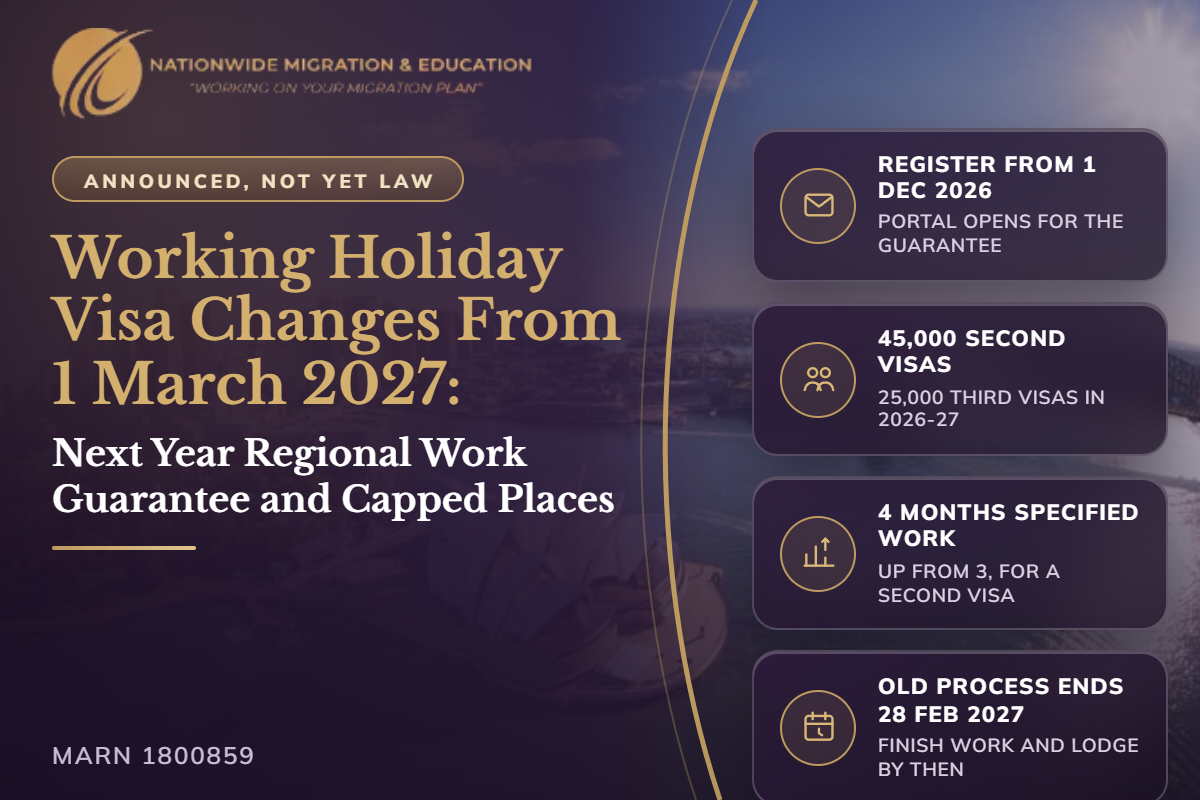
On 17 November 2026 the Minister for Home Affairs, Tony Burke, announced how second and third Working Holiday Maker visas will work from next year. The date that matters most is 1 March 2027. Before it, the current process applies. From it, you will need something new called a Next Year Regional Work Guarantee, and the number of visas will be capped.
We are Nationwide Migration and Education, a Brisbane migration agency and a team of registered migration agents at 320 Adelaide Street, Brisbane. Here is what the Minister announced, what is still unknown, and what to do about it now.
Announced, not yet law
This is an announcement in a ministerial media release. As at 17 November 2026 no regulation or legislative instrument has been made to put it into effect. The detail can still change before it becomes law, and some important parts have not been published at all. We will say clearly below which is which.
The changes cover both Working Holiday Maker visas: the Working Holiday visa (subclass 417) and the Work and Holiday visa (subclass 462).
The key dates for second and third Working Holiday visas
Date | What happens | Status |
1 December 2026 | A portal opens to register interest in a Next Year Regional Work Guarantee | Announced |
Mid-January 2027 | First monthly invitation round expected | Announced, "expected" |
28 February 2027 | Last day for current Working Holiday Makers to finish their specified work and lodge a valid application under the existing process | Announced |
1 March 2027 | A Guarantee is needed to apply for a second or third visa (except UK citizens). Specified work for a second visa rises from three months to four | Announced |
30 June 2027 | Registrations remain valid until this date | Announced |
What is the Next Year Regional Work Guarantee?
From 1 March 2027, a person seeking a second or third Working Holiday Maker visa will need to hold a Next Year Regional Work Guarantee. UK citizens are the exception.
According to the media release, you get the Guarantee in two steps:
1. You register your interest through a portal, which opens on 1 December 2026.
2. You are invited to apply. Invitation rounds will be monthly, with the first expected in mid-January 2027.
An invitation is valid for 12 months and allows the person to apply for the visa. A registration stays valid until 30 June 2027.
The release does not say how people will be chosen for invitation in each round. It does not say whether registering costs anything, what you must show when you register, or whether you need to have finished your specified work before you register. Until the Department publishes that detail, nobody can tell you your chances, and you should be careful of anyone who says they can.
How many places: 45,000 second visas and 25,000 third visas
The Minister announced 45,000 second visa places and 25,000 third visa places for 2026-27.
This is the first time second and third visas have had a fixed number of places attached to them in this way. Doing your specified work has, until now, been enough to qualify you to apply. From 1 March 2027 it will be one of two things you need. The other is an invitation.
Specified work for a second visa: three months becomes four
From 1 March 2027 the specified work requirement for a second visa increases from three months to four months, "where the requirement applies".
Two points in the announcement soften this:
Work you complete before 1 March 2027 counts towards the new four-month requirement. You do not start again.
The requirement for a third visa stays at six months.
The media release does not list any change to the kinds of work or the areas that count as specified work.
What changed since the September announcement
The Minister first announced a cap on second and third visas at the National Press Club on 17 September 2026. We wrote about it at the time. Three things are different in the version announced on 17 November:
Announced 17 September 2026 | Announced 17 November 2026 | |
How places are given out | A ballot | Registration of interest, then monthly invitations |
Third visa places | 5,000 | 25,000 |
Second visa places | 45,000 | 45,000 |
Specified work for a second visa | Unchanged at three months | Four months |
The media release says the Government worked with peak industry groups on the design after the September address. The larger third visa number and the move away from a ballot are the result.
The transition: who can still use the current process
The release says current Working Holiday Makers "will have until 28 February 2027 to complete the relevant specified work and lodge a valid application under the existing process".
In plain terms, if you can do both of these by 28 February 2027, the existing rules apply to you:
1. Finish the specified work the current rules require (three months for a second visa, six months for a third), and
2. Lodge a valid application for the next visa.
Both parts matter. Finishing your work in February and lodging in March would put you on the wrong side of the line. So would lodging an application that turns out not to be valid.
Who is affected and what to do
Your situation | What the announcement means for you |
On a first visa, specified work already done | You can apply now under the existing process. Lodging before 28 February 2027 avoids the new system |
On a first visa, specified work part done | Work out whether you can reach three months and lodge by 28 February 2027. If not, expect to need four months and a Guarantee |
On a second visa, aiming for a third | Same deadline. Six months of specified work and a valid application by 28 February 2027, or the Guarantee process after that |
UK citizen | The media release excepts UK citizens from the Guarantee requirement |
Not yet in Australia, or just arrived | Plan for the new system: registration, invitation, and four months of specified work for a second visa |
Employer who relies on backpackers | Staff who planned to stay a second or third year may now be working to the 28 February deadline, or may not get a place. Ask them now |
If you can lodge before 28 February 2027, do not leave it to the last week. Get your payslips and employment evidence in order as you go. Missing or inconsistent evidence of specified work is one of the most common problems we see in second visa applications.
If you cannot make the deadline, register when the portal opens.Registrations open on 1 December 2026 and remain valid until 30 June 2027. Read the Department's instructions when they are published before you register.
Employers. Farms, tourism operators and hospitality businesses in regional Queensland plan rosters around second-year backpackers. A capped system makes that less certain. If you have a worker you want to keep for the long term, a Working Holiday visa was never a secure way to do it. Depending on the occupation and the worker, employer sponsorship may be an option, and it is better explored months before a visa runs out than weeks.
What we do not know yet
How invitations will be allocated in each round
What the registration asks for, and whether there is a charge
How the 45,000 and 25,000 places for 2026-27 are counted, including whether visas applied for before 1 March 2027 count towards them
The wording of the regulations or instrument, which will be the law once made
We will update this article when the Department publishes the detail or the law is made.
Three things to bring us
We do the straightforward matters and the complicated ones: refusals, cancellations, tribunal reviews, health and character problems. If your file is messy, it is not our first messy file.
Book a consultation at https://nationwidemigration.com.au/services or call our Brisbane office on +61 7 3726 5183.
1. Your passport and current visa grant notice, so we can see which visa you hold and when it ends
2. Your specified work evidence so far: payslips, employer details, dates and postcodes
3. Your plan after the working holiday: another year, study, an employer who wants to keep you, or a partner in Australia
General information only, current as at 17 November 2026. Not migration advice for your specific circumstances
