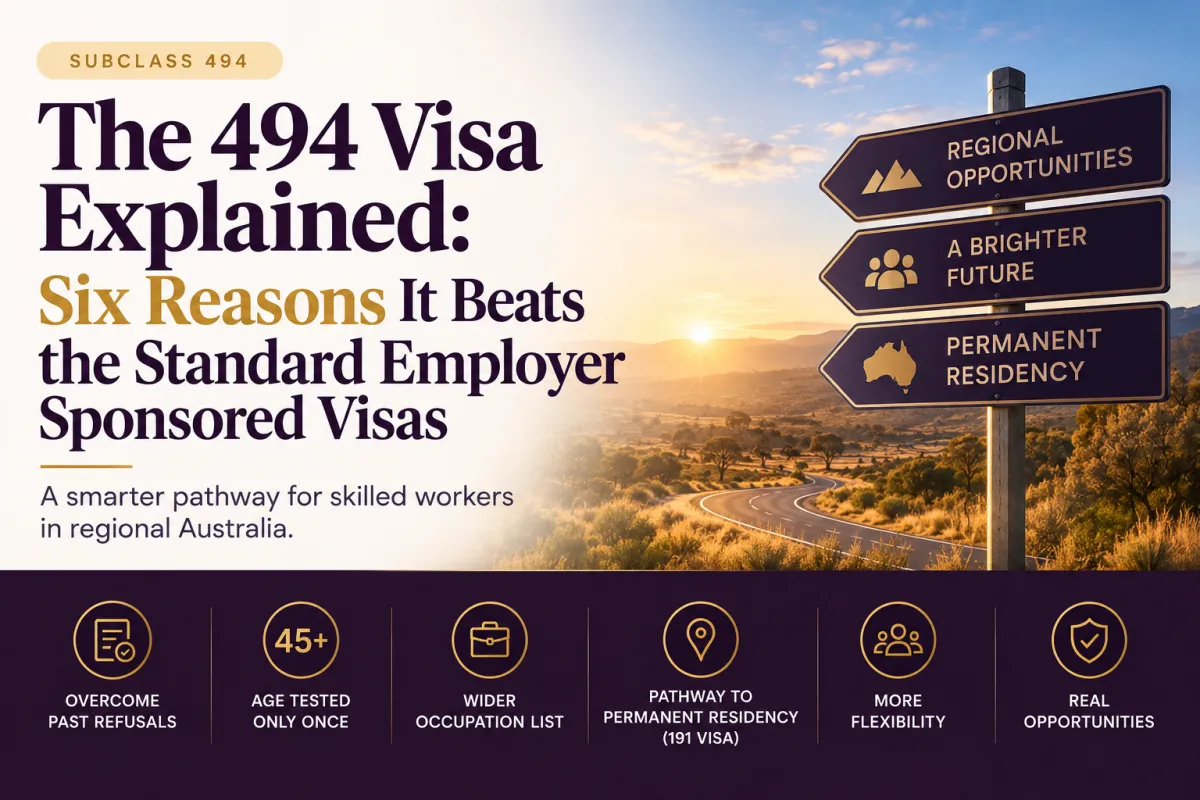
494 Visa Explained: Six Reasons to Consider It
There is a visa in the Australian employer sponsored program that most people have never heard of. It does not get marketed, it rarely gets discussed, and yet it solves problems the more popular visas simply cannot solve.
It is thesubclass 494 Skilled Employer Sponsored Regional (Provisional) visa.
We are Nationwide Migration and Education, a team of registered migration agents, and employer sponsored visas are what we do every day. Below are six reasons the 494 can be a better visa than the standard subclass 482 or subclass 186, what youactually needto qualify, and an honest account of where it falls short.
Reason one: a past refusal does not stop you
Section 48 of theMigration Act 1958is the rule that ends most of these conversations.
If you are in Australia, you do not hold a substantive visa, and you have had a visa refused or cancelled since you last arrived, section 48 stops you making most further applications onshore. Youhave toleave the country to apply again. For a great many people with an employer willing to sponsor them, that is where it ends.
But section 48 does not apply to every visa. Regulation 2.12 prescribes a list of visa classes that are carved out of it, andthe subclass 494 is on that list.
So a past refusal does not prevent you lodging a 494 from inside Australia. You are not forced offshore, you do not have to break your employment, and your employer does not have to hold a vacant role open while you arrange a departure and a return.
There is a second point that travels with it. The 494 carriesno Schedule 3 criteria. On some visas a period of being unlawful has to be formally excused before the application can succeed. That hurdle does not exist here.
One honest limit. Section 48 not applying does not make the refusal disappear. Your history still goes to your character assessment, to the Public Interest Criteria, and to how a delegate reads the genuineness of the arrangement. What this gives you isthe right to be assessed at all, from where you already are. For a lot of people, that is the whole ball game.
Reason two: your age is only ever tested once
This is the reason that costs people the most, and it almost always lands in the final twelve months.
On the standard route you must beunder 45 at the time you apply for permanent residence. That test sits at clause 186.221(b) for the Temporary Residence Transition stream and clause 186.231(b) for Direct Entry. Not when you arrived. When you lodge the permanent application, years later.
So people arrive at 41, do everything right for four years, and age out at the finish line.
The 494 works differently. It tests your ageonce, at clause 494.223(2), when you lodge the 494 itself. And the permanent visa it leads to,the subclass 191, has no age criterion at all.
Do the arithmetic. Lodge the 494 at 44. Work three years in a designated regional area. Lodge the 191 at 47, or 48. Nobody asks your date of birth. The question is simply not put.
The age exemptions are wider than on the 186
If you are already over 45, do not assume the door is shut. The exempt classes for the 494 age cap sit in section 8(1) of LIN 19/216 and cover academic applicants, science applicants, regional medical practitioners, subclass 444 and 461 workers, and subclass 457 or 482 workers meeting the high income pathway.
The equivalent list for the 186 Direct Entry stream, at section 6(2), is narrower. It doesnotinclude regional medical practitioners.
The practical consequence catches out a lot of advisers. An over-45 doctor working regionally cannot use the 186 Direct Entry stream on that basis, but may well be able to use the 494.
Reason three: a much wider occupation list
The subclass 482 and the subclass 186 Direct Entry stream both run off the same list, the Core Skills Occupation List.
The 494 does not. It runs offLIN 19/219, which combines the Medium and Long-term Strategic Skills List with an extended Regional Occupation List. It is considerably wider, and there are occupations that do not appear anywhere on the standard list that do appear on this one.
We deliberately do not publish occupation lists in articles like this, and we would encourage you to be sceptical of anyone who does. These are legislative instruments. They are amended without much fanfare, and a list that was accurate in March can be wrong by September. Checking your specific ANZSCO code against the current instrument takes us minutes. Reading a stale list off a website can cost you a year.
One related warning. TheOccupation Shortage List, published each October by Jobs and Skills Australia, tells you whether an occupation is in shortage. It does not tell you whether that occupation can besponsored. Those are two completely different documents, and conflating them is the most common error in migration marketing.
Reason four: your employer does not sponsor you again for permanent residence
This is the structural difference that matters most, and almost nobody discusses it.
On the 482 to 186 route, your employer sponsors youtwice. Once for the temporary visa, and again, years later, for the permanent one. That second nomination is a fresh application, with a fresh fee, a fresh training levy, and a fresh decision by your employer about whether to proceed.
Which means that at the exact moment permanent residence is finally within reach, your entire migration outcome is sitting in somebody else's inbox. If the business has been sold, if it has gone into administration, if the owner has retired, or if the relationship has simply gone cold, you have no permanent visa and very little leverage.
The subclass 191 has no employer nomination.
None. No nomination application, no Skilling Australians Fund levy, no labour market testing, nothing for your employer to sign and nothing for them to pay. You lodge the 191 yourself, in your own name.
What you must show instead is that you held the 494, and that you complied with its conditions, in particularcondition 8579, which requires you to live, work and study only in a designated regional area.
That is a fundamentally different relationship. On the 482 route your employer holds your permanent residence. On the 494 route,youhold it.
And the income requirement people worry about does not exist
There is a persistent belief that the 191 requires a minimum taxable income of $53,900 for each of three years. That figure was announced in October 2019 and repeated everywhere since, butno minimum income threshold is applied.
The Department of Home Affairs position is that there is no minimum income requirement for the subclass 191. What primary applicants must provide isnotices of assessment issued by the ATOfor three income years out of the five years of the eligible visa.
The requirement is documentary, not financial. Payslips, tax returns and accountant letters do not substitute for the actual notices of assessment. So the practical instruction is simple: lodge your tax returns on time, every year you hold the 494.
Reason five: five years in one grant, and it costs your employer less
This is the reason to put in front of the person who has to say yes to sponsoring you.
Five years in a single decision.No renewal halfway through, and no second round of fees, paperwork and legal costs at year three.
No nomination fee.The 494 nomination fee is nil. The 482 is $330 and the 186 is $540.
A one-off training levy instead of an annual one.The 494 levy is a single payment of $3,000 for a business under $10 million turnover, or $5,000 at or above it. The 482 levy is charged per year of the nomination, so a five year sponsorship through the 482 costs an employer roughly double.
If you are asking an employer to commit, that last figure is the one to show them.
Reason six: Medicare, your partner, and no points test
Three smaller points that matter a great deal in daily life.
Medicare.Subclass 494 holders can enrol in Medicare under the Ministerial Order covering certain temporary residents, which you cannot do on a 482. Note carefully that condition 8501 still applies, so you must maintain adequate health insurance as well. Medicare enrolment does not release you from that visa condition.
Your partner is not tied to your employer.Condition 8608 restricts the primary holder to the sponsoring employer and the nominated occupation. Secondary applicants are not subject to it. Your partner can work for any employer, in any role, full time. They remain bound by condition 8579 to a designated regional area, but not to your boss.
No points test, no expression of interest, no invitation round.This is where the 494 differs sharply from the subclass 491, which people constantly confuse it with. The 491 requires points, an EOI, a state or territory nomination and an invitation. The 494 requires one thing: an employer.
And one bonus that people overlook. The three years you spend on the 494 count toward the four years of lawful residence required for citizenship. Since you also need twelve months as a permanent resident, citizenship is realistically about a year after the 191 is granted.
"Regional" is much bigger than you think
This is where most people wrongly disqualify themselves before they ever pick up the phone.
UnderLIN 22/022, the only areas excluded from the designated regional area definition are metropolitan Sydney, Melbourne and Brisbane.
Everywhere else qualifies. Perth. Adelaide. Canberra, Hobart, the Gold Coast, Newcastle, Wollongong and Geelong. The entirety of South Australia, Western Australia, the Northern Territory, Tasmania and the ACT. Most of the Mornington Peninsula and the Yarra Valley. So does the Hawkesbury.
If you pictured a mining town, adjust the picture.
What you actually need to qualify
Six things:
An employer with a position in a designated regional area, and that position must be genuine and likely to exist for at least five years.
Your occupation on the 494 list(LIN 19/219).
Under 45at the time of application, unless an exemption applies.
Three years of full time work experiencein the nominated occupation.
A positive skills assessmentfrom the authority specified in LIN 19/260. This one is mandatory for the 494 and it catches people out, so budget the time and the cost for it early.
Competent English, which is IELTS 6.0 in each band or the equivalent in another accepted test.
The trade offs, stated honestly
No visa is free of them, and any adviser who presents the 494 without these is selling rather than advising.
It is slower to permanent residence
Since 25 November 2023 the 482 to 186 Temporary Residence Transition route requires two years. The 494 to 191 route requires three. If you are 30, comfortably on the standard occupation list, and have a stable employer, the 482 is very likely your better visa. The 494 earns its place when one of those six reasons is actually a problem in your case.
The entry bar is higher
Competent English at IELTS 6.0 against 5.0 for the 482. Three years of experience against twelve months. And a mandatory skills assessment where the 482 usually has none. That is real cost and real lead time, and it belongs in your budget and your timeline from day one.
Labour market testing always applies
The Immigration Talent Obligation exemptions that can remove labour market testing for some 482 nominations do not apply to the 494.
There is a three year lock in
A 494 holder cannot apply for a subclass 186, 188, 189, 190, 191, 858, or 820/801 partner visa in the first three years after grant. If a partner visa is anywhere on your horizon, that has to be discussed before you lodge the 494, not after.
And regional no longer means faster
It used to. Ministerial Direction 105 gave the highest processing priority to nominations and visa applications for positions in a designated regional area.Ministerial Direction 119commenced on 25 July 2026 and removed that tier entirely. The claim is still circulating widely in migration marketing. It is now simply wrong.
What to do next
The 494 is not the right visa for everybody. It is the right visa for a specific and quite large group: those with a refusal in their history, those approaching 45, those whose occupation is not on the standard list, and those who would rather not have their permanent residence sitting in an employer's inbox three years from now.
Working out which group you are in takes one conversation.
Send us three things:
Your age
Your job title
Where the job is located
Those three facts tell us whether the 494 is worth pursuing for you. We are Nationwide Migration and Education, a team of registered migration agents, and working that out is our job, not yours.
Disclaimer
This article is general information only and is current as at the date of publication. It does not take your personal circumstances into account and it is not immigration assistance. Migration law changes frequently. For advice on what may apply to your situation, speak with a Registered Migration Agent.
Nationwide Migration and Education. Suman Dua, Registered Migration Agent, MARN 1800859. We are not affiliated with the Australian Government and we cannot guarantee a visa outcome or influence processing times.
