Every Active DAMA Region in Australia in 2026 (and Which One Fits Your Business)
📌 Published by Nationwide Migration & Education
Author: Suman Dua, Registered Migration Agent (MARN: 1800859)
_________________________________________________________________________________________________
If you run a regional business and you keep losing good candidates because they're too old for a standard skilled visa, can't hit the English score, or work in an occupation that isn't on the usual list, a Designated Area Migration Agreement (DAMA) is often the answer. DAMAs were built precisely for the situations standard programs don't handle well.
There are around 13 active DAMAs across Australia in 2026, each tied to a specific region with its own occupation list, its own representative, and its own set of concessions. This guide walks through every one, what it covers, and how to work out which fits your business.
What a DAMA Actually Is
A DAMA is a regional labour agreement between the Australian Government and a local body called the Designated Area Representative (DAR). It lets employers in that region sponsor overseas workers on the subclass 482 (Skills in Demand) and subclass 494 visas, with a pathway to permanent residence through the subclass 186 (Employer Nomination Scheme).
The reason employers use a DAMA rather than the standard program comes down to concessions:
Age — workers up to 55 and beyond can be sponsored where the standard cut-off would rule them out.
English — lower thresholds apply, in some cases IELTS 5.0 with no individual band minimum for particular roles.
Salary — concessions on the minimum salary (CSIT/ TSMIT) for certain occupations.
Occupation access — DAMA lists are broader and more locally relevant than the standard skilled occupation lists, often including roles you simply can't sponsor any other way.
Crucially, every DAMA has its own occupation list and its own DAR, and the employer needs DAR endorsement before lodging the labour agreement request with the Department. That endorsement step is where most of the regional knowledge matters.
The Active DAMA Regions in 2026
Northern Territory — NT DAMA III
The NT DAMA is the largest and most generous in the country. NT DAMA III commenced 19 March 2025, offers roughly 1,500 places per year, and covers around 325 occupations across the whole Territory.
Industries span hospitality, construction, health and aged care, trades, agriculture, transport and professional roles. If you're in the NT, this is one of the deepest occupation lists available anywhere in Australia.
Orana, NSW (Dubbo and Central West)
The Orana DAMA covers the Dubbo region and surrounding Central West NSW, with around 129 occupations. It's strong for agriculture, food processing, health, trades and hospitality — the backbone industries of inland NSW.
RDA Southern NSW and ACT
This agreement covers the Southern NSW region together with the ACT, supporting employers in areas where standard skilled migration struggles to fill roles. Health, aged care, hospitality, agriculture and trades feature heavily.
Far North Queensland (Cairns)
The FNQ DAMA, administered out of Cairns, supports the tourism, hospitality, agriculture, marine and construction industries that drive the region. It's one of two Queensland DAMAs and a natural fit for businesses across the Cairns and Far North catchment.
Townsville North Queensland
The Townsville DAMA covers North Queensland's largest regional city and its surrounds, with a focus on construction, health, manufacturing, trades and hospitality. Together with FNQ it gives Queensland regional employers two distinct routes depending on location.
Adelaide and South Australia
South Australia runs two agreements:
Adelaide City Technology and Innovation Advancement Agreement — aimed at tech, innovation and skilled professional roles in metropolitan Adelaide.
South Australian Regional Workforce Agreement — covers regional SA across a broad set of industries, extended to 30 June 2026.
SA was an early and active adopter of the DAMA model and the lists remain broad.
Goulburn Valley, Victoria
Centred on Shepparton and the Goulburn Valley, this DAMA is built around the region's food production, processing, agriculture and horticulture economy, along with health and trades.
Great South Coast, Victoria
Covering Warrnambool and south-west Victoria, this DAMA supports dairy, agriculture, food processing, health and trades — the industries that anchor the region.
Western Australia — State-Wide Plus Regional Agreements
WA operates a state-wide DAMA alongside several regional agreements: Goldfields, Kimberley, Pilbara and South-West. These cover mining and resources, construction, hospitality, agriculture, health and trades.
One important change to note: the Goldfields DAMA ends 30 June 2026. From 1 July 2026, Goldfields employers move under the WA (state-wide) DAMA. If you're a Goldfields business, plan your applications around that transition.
DAMA Regions at a Glance
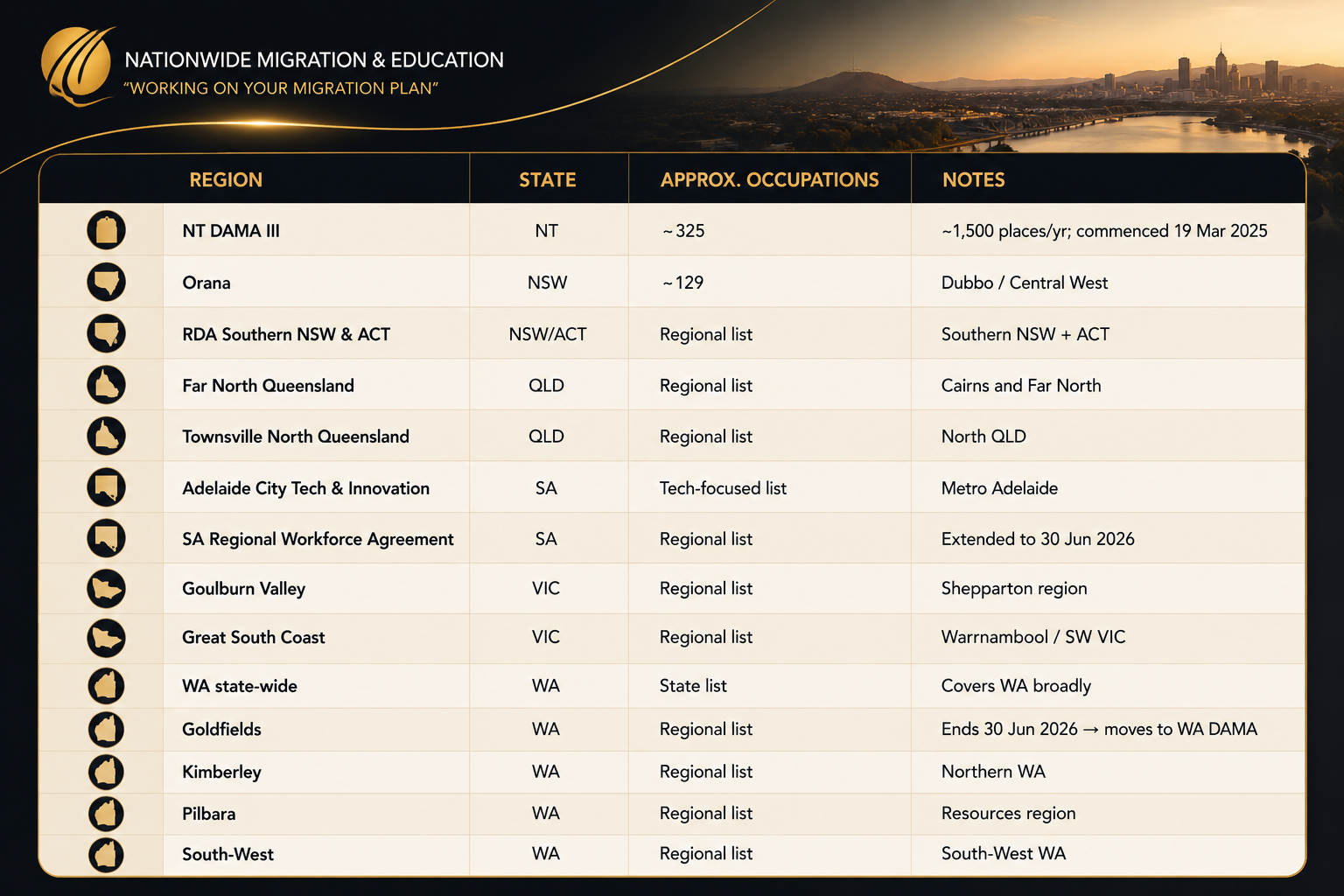
Occupation counts and place numbers move over time and lists differ by region. Always confirm the current list for your area before committing.
How to Choose the Right DAMA
The right DAMA is almost always decided by one thing first: where the work is physically performed. A DAMA only applies to the designated area it covers, so your business location (or the location of the role) sets the shortlist.
From there, work through:
Is your occupation on that region's list? Lists vary widely. A role available under the NT DAMA may not exist under a WA regional list, and vice versa.
Do you need the concessions? If your candidate is over the standard age cut-off, sits below the usual English requirement, or the role pays under TSMIT, a DAMA may be the only viable path.
What's your timeline? Some agreements have end dates or transition points (SA Regional to 30 June 2026; Goldfields to the WA DAMA from 1 July 2026). Timing affects which agreement you lodge under.
Can you secure DAR endorsement? Each region's DAR has its own evidence requirements around genuine need, labour market testing and local benefit. This is the practical gatekeeper.
Frequently Asked Questions
Which DAMA has the most occupations?
The NT DAMA III is the broadest, with around 325 occupations and roughly 1,500 places a year, covering most major industries across the Territory.
Can a DAMA lead to permanent residence?
Yes. The standard pathway is to work on a subclass 482 or 494 visa under the DAMA and transition to permanent residence via the subclass 186 (Employer Nomination Scheme), subject to meeting the requirements.
Do I have to be located in the region to use its DAMA?
The role generally must be performed in the designated area the DAMA covers. Your business location and where the work is done determine which DAMA you can access.
What is a DAR and why does it matter?
The Designated Area Representative administers the DAMA for its region. You need the DAR's endorsement before you can lodge the labour agreement request with the Department, so the DAR is the first practical step.
Is the Goldfields DAMA closing?
The Goldfields DAMA ends 30 June 2026. From 1 July 2026, Goldfields employers come under the WA (state-wide) DAMA. Plan applications around that change.
Talk to Us Before You Commit
DAMAs reward employers who pick the right region, confirm the occupation, and approach the DAR with the right evidence the first time. Getting that sequence wrong costs months. With 322+ five-star Google reviews, Nationwide Migration & Education helps regional and city employers across Australia work out exactly which DAMA fits and run the process end to end.
Disclaimer
This article is general information only and not immigration advice. Nationwide Migration & Education is not affiliated with the Australian Government and does not issue visas. For advice on your situation, book a consultation with one of our Registered Migration Agents.
