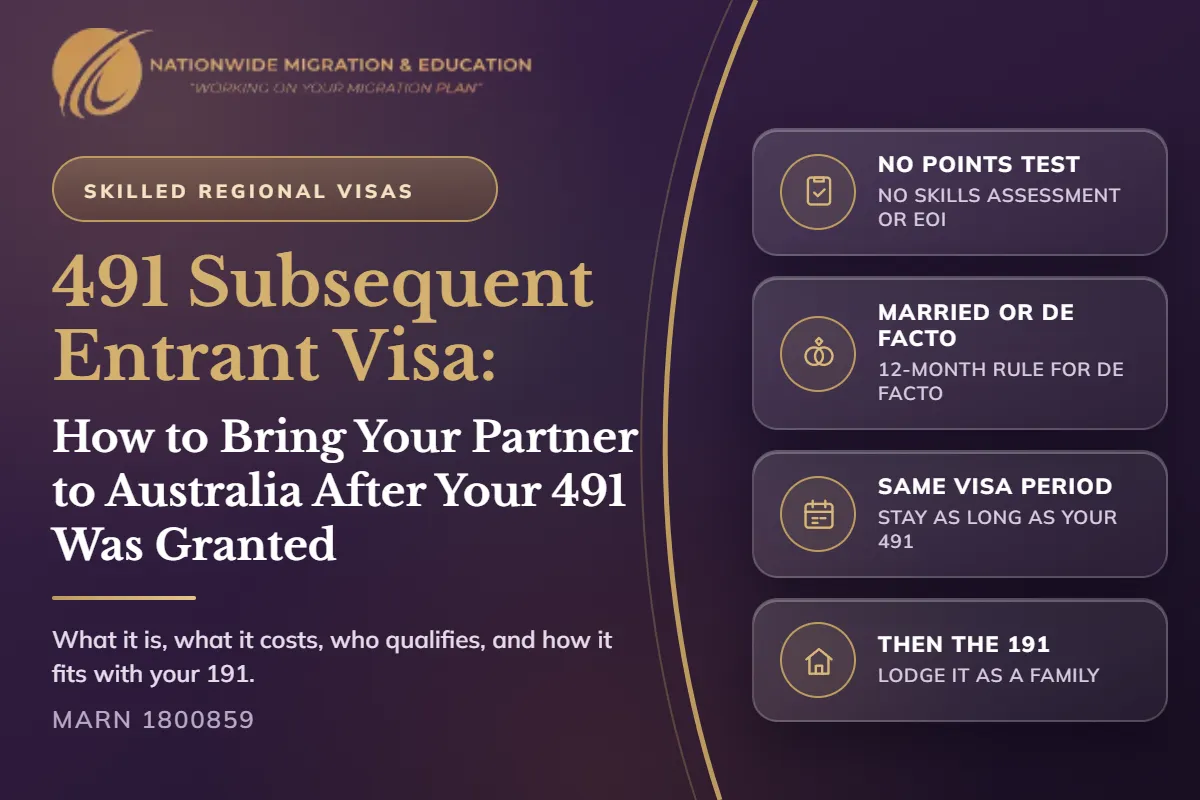
491 Subsequent Entrant Visa: How to Bring Your Partner to Australia After Your 491 Was Granted (2026)
You got your subclass 491. You moved to regional Australia, you started the job, and you are counting down the three years to permanent residence. Then life happened. You got married, or you moved in with someone and it is serious. Now the question is how to get your partner here, and whether they have to go through everything you went through.
They do not. We are Nationwide Migration and Education, a Brisbane migration agency, and this exact situation comes through our door constantly. Most people arrive having been told something wrong. This article sets out what the 491 subsequent entrant visa is, what it costs, who qualifies, and how it fits with your 191 permanent residence application.
First, the three things people get wrong
"My partner needs their own points."No. The subsequent entrant criteria do not include a points test, a skills assessment, an expression of interest, an invitation or a state nomination. Those requirements sit only in the main applicant criteria. Your partner applies on the strength of your visa.
"I'll sponsor a partner visa." You cannot. A partner visa sponsor must be an Australian citizen, an Australian permanent resident or an eligible New Zealand citizen. On a 491 you are none of those yet.
"My partner waits overseas until my 191 comes through." That is three years apart at a minimum, for no reason. There is a visa designed for exactly this gap.
What the 491 subsequent entrant visa is
The Department of Home Affairs describes it plainly: a visa "for a member of the family unit of someone who holds a Skilled Work Regional (Provisional) visa (subclass 491)". A member of the family unit includes your spouse or de facto partner, and dependent children.
Your partner lodges their own 491 application. It is assessed against the family-member criteria, not the skilled criteria. Three things do the work:
1. You still hold your 491, granted on the basis of the primary criteria.
2. The relationship is genuine. For married couples, a valid marriage. For de facto couples, see the twelve-month rule below.
3. Your partner meets health and character, repays any debts to the Australian Government, and signs the Australian values statement.
Applicants aged 18 or over must also have at least functional English, or pay a second charge. More on that below, because it is the figure that catches people.
Inside or outside Australia
Your partner can apply from inside or outside Australia, but not while in immigration clearance. If they apply in Australia they must hold a substantive visa, or a Bridging visa A, B or C, at the time they lodge. Otherwise the application is not valid. This is a point to check before anyone books a flight: a partner who is in Australia on a visa that is about to end, or on the wrong bridging visa, needs advice before lodging, not after.
What it costs in 2026
From 1 July 2026 the Home Affairs charges for a subclass 491 are:
Applicant | Charge |
Main applicant | AUD 6,140 |
Additional applicant 18 or over | AUD 3,070 |
Additional applicant under 18 | AUD 1,535 |
Second instalment, each applicant 18+ with less than functional English | AUD 4,890 |
A point that surprises people: a spouse lodging a subsequent entrant application on their own is the main applicant of that application. They pay the AUD 6,140 charge, not the AUD 3,070 additional-applicant charge. If a child lodges with them, the child is the additional applicant.
The English charge.If your partner is 18 or over and does not have at least functional English, the Department will ask for a second instalment of AUD 4,890 before the visa is granted. It is only requested if the visa is going to be granted, but it is still nearly five thousand dollars. Functional English can be shown by a recognised English test result, or by certain study history. An English test before lodging is often the cheapest decision in the whole application.
The twelve-month rule for de facto couples
The Migration Regulations require a de facto applicant for a General Skilled Migration visa, which includes the subclass 491, to have been in the de facto relationship for at least twelve months immediately before applying. Two exceptions:
A registered relationship.If your relationship is registered under a prescribed state or territory register, the twelve-month requirement does not apply. Registers are prescribed in New South Wales, Victoria, Queensland, South Australia, Tasmania and the Australian Capital Territory. Western Australia and the Northern Territory do not have a prescribed register.
Compelling and compassionate circumstances, which must be established on the evidence.
Home Affairs asks for either evidence of a registered relationship, or enough documents to show the relationship has existed for twelve months. The relationship evidence itself covers the same four areas as any partner case: finances, household, social life and commitment.
What the visa gives your partner
The same visa period as yours.Home Affairs states the subsequent entrant can stay "until the visa that your family member holds ends". Your 491 is valid for five years from the date it was granted to you, so a partner joining two years in gets the remaining three. The visa cannot be extended.
Full work and study rights, in a designated regional area.
The same regional condition.Condition 8579 requires every 491 holder, including family members, to live, work and study only in an area that was on the designated regional area list on the date the visa was granted. The map that applies is the one at your grant date. This is the condition that decides the 191 later, so your partner needs to understand it from day one.
No health insurance condition.The 491 carries conditions 8515, 8578, 8579, 8580 and 8581. Condition 8501 is not among them. Private cover is still sensible, but it is not a visa condition.
How long it takes
Home Affairs does not publish a separate processing time for subsequent entrants. They are counted in the stream of the primary holder's visa. For decisions to the end of August 2026, published 29 September 2026:
491 stream | 50% decided within | 75% | 90% |
State or Territory nominated | 5 months | 16 months | 18 months |
Family sponsored | 4 months | 5 months | 7 months |
Treat these as a planning guide, not a promise. They move every month.
How it fits with the 191
The subclass 191 is the permanent residence visa for 491 and 494 holders. You must have held your 491 for at least three years, complied with its conditions, and provide ATO notices of assessment for three income years out of the five years of the visa. There is no minimum income requirement.
On family members, the Home Affairs 191 page says: "Generally, family members included in your application do not need an eligible visa." You can include them when you lodge the 191 or add them before it is decided, and they must meet health and character.
So the subsequent entrant visa is not a prerequisite for your partner to be included in your 191. What it does is far more practical: it lets your partner live and work in Australia with you during the three or more years before the 191 is possible, instead of waiting overseas. When the time comes, you lodge the 191 as a family.
A note on timing
On 2 October 2026 the government removed subsequent entrants from the Student visa. Current student visa holders can no longer add family members after grant, in any circumstance, with no exemptions. The change was made by regulation and took effect the next day.
We are not saying the 491 subsequent entrant pathway is closing. No change has been announced. We are saying that the rules in this space move without warning, and an application that can be lodged today should be lodged today rather than next year.
How we handle a 491 subsequent entrant application
First, we confirm your 491 is in effect and check your partner's current visa and location, because onshore lodgement has its own validity rules.
Second, we check the relationship timing. For de facto couples that means the twelve-month rule, whether registering the relationship in Queensland is the right answer, and what evidence exists across the four areas.
Third, we deal with English before lodging, because a test result can save nearly five thousand dollars.
Fourth, we build the file so it also serves the 191 later: the relationship evidence, the regional address history, and the condition 8579 record.
What to bring to your consultation
1. Your 491 grant letter, which shows your grant date and conditions.
2. Your partner's passport and current visa, if they hold one.
3. An honest timeline of the relationship, with dates. When you met, when it became serious, when you moved in or married.
We are Nationwide Migration and Education, a team of registered migration agents at 320 Adelaide Street, Brisbane. We do the straightforward matters and the complicated ones: refusals, tribunal reviews, thin relationship evidence, health and character problems. If your file is messy, it is not our first messy file.
Need migration advice or help with a 491 subsequent entrant application? Book a consultation at https://nationwidemigration.com.au/services or call our Brisbane office on +61 7 3726 5183.
General information only, current as at October 2026. Not migration advice for your specific circumstances. Fees and processing times are those published by the Department of Home Affairs at the dates shown and change without notice.
