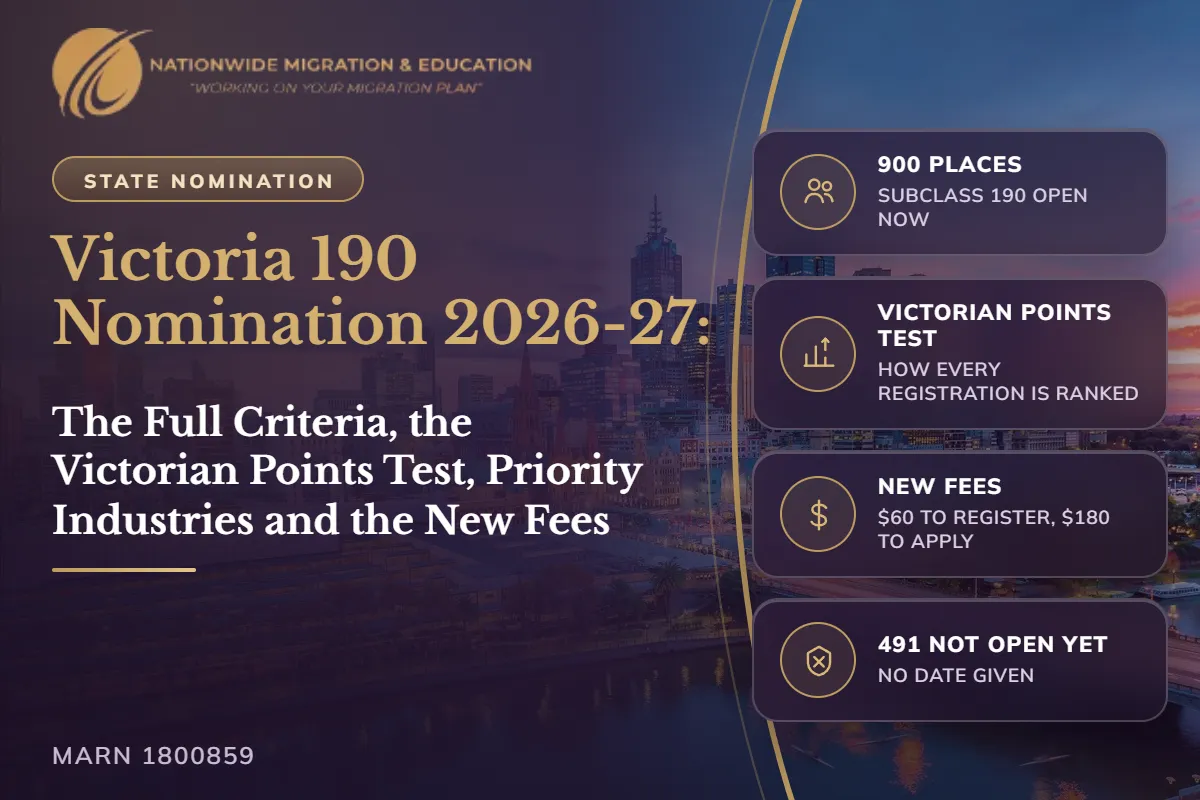
Victoria 190 State Nomination 2026-27: The Full Criteria, the Victorian Points Test, Priority Industries and the New Fees
If you hold a SkillSelect Expression of Interest and Victoria is the state you want, this is the year the rules changed on three fronts at once. Victoria's 2026-27 skilled visa nomination program opened for the Skilled Nominated visa (subclass 190) on 26 October 2026 with 900 places. For the first time there are fees to register your interest and to apply for nomination. And Victoria has named and published the test it uses to rank every registration, the Victorian Points Test, including the exact points for each factor and the occupations it is prioritising this year.
We are Nationwide Migration and Education, a Brisbane migration agency and a team of registered migration agents. We lodge state-nominated applications every week. This article sets out, in one place, what Victoria requires for subclass 190 nomination in 2026-27, how it decides who gets invited, the fees, and the mistakes that get nominations refused. Everything here is taken from the Victorian Government's Live in Melbourne website and is current as at 2 November 2026. Victoria states that its nomination requirements and priorities can change throughout the year without notice, so check the Live in Melbourne pages before you act.
What is open in Victoria for 2026-27, and what is not
The subclass 190 is open. Victoria has been allocated 900 nomination places for the Skilled Nominated visa (subclass 190) in 2026-27 and has been accepting Registrations of Interest (ROIs) since 26 October 2026. Invitation rounds run throughout the program year with no set dates, and the program will close to new ROIs at some point in 2027 on a date yet to be advised.
The subclass 491 is not open.Victoria's 2026-27 places for the Skilled Work Regional (Provisional) visa (subclass 491) have not been finalised. Victoria is not accepting ROIs for the 491 and has given no date. It says further information will be published once the 491 places are confirmed. If regional Victoria was your plan, there is nothing to lodge yet.
Last year's registration does not count.An ROI is valid only for the program year in which it is submitted. If you registered with Victoria in 2025-26 or earlier, you must log in to the Live in Melbourne portal and submit a new ROI to be considered in 2026-27.
The seven Victorian nomination criteria for the subclass 190
To be eligible to apply for Victorian nomination you must meet both the Department of Home Affairs' requirements for the subclass 190 visa and Victoria's own nomination requirements. Victoria lists seven:
1. Be living in Victoria or living overseas.If you are in Australia, you must be living in Victoria. Victoria has said it will not select ROIs from onshore applicants living in any other state or territory. The only exceptions are case-by-case decisions for border communities: people who live and work in a Victorian border town, live in a Victorian border town but work across the border, or work in a Victorian border town but live across the border. Offshore applicants are eligible and must be committed to living in Victoria if the visa is granted.
2. Be committed to living and working in Victoria. Nomination comes with a commitment to live and work in Victoria for at least two years. For offshore applicants the two years start when you arrive in Australia; for onshore applicants they start at visa grant. State nomination cannot be transferred to another state.
3. Have your ROI selected. You cannot apply for nomination until Victoria invites you. An ROI is not an application, and Victoria says there is no guarantee it will be selected.
4. Be under 45 years of age at the time of nomination.
5. Have at least Competent English. Victoria also requires your English test to have at least 12 weeks' validity remaining when you lodge the nomination application, so it has time to assess you. It will not nominate you on an expired test. Passport holders of the United Kingdom, Canada, New Zealand, the United States or the Republic of Ireland do not need a test result.
6. Hold a valid skills assessmentin an occupation on the Australian Government's eligible skilled occupation list for the subclass 190. The assessment must be a full assessment (a provisional skills assessment issued for a Temporary Graduate visa, subclass 485, is not sufficient), it must match the occupation in your SkillSelect EOI, and it must also have at least 12 weeks' validity remaining at nomination application. Health practitioners' occupations must be consistent with their AHPRA registration.
7. Have at least 65 pointson the Australian Government's points test in your SkillSelect EOI, including the 5 points for state nomination.
What Victoria does not require
Three things people assume are requirements are not. There is no requirement to be working, no minimum work experience or hours, and no minimum earnings. You can be living in Victoria without a job and still be eligible for nomination. Earnings matter only as a ranking factor, covered below, and only if you have them.
Victoria also confirms that recent graduates and PhD students are eligible, provided they meet the same seven criteria.
How Victoria decides who gets invited: the Victorian Points Test
Eligibility gets you into the pool. Victoria then ranks every ROI in that pool using the Victorian Points Test (VPT), which is separate from, and sits on top of, the federal SkillSelect points test. Your SkillSelect score of 65 or more makes you eligible. Your VPT total decides whether you are invited.
The VPT has no pass mark. In each invitation round Victoria invites the ROIs with the highest VPT totals in the pool at that time, so your outcome depends on who else has registered. Victoria says it cannot tell you your likelihood of invitation or how your points compare, and it will not prioritise anyone on personal circumstances such as age or an expiring visa.
The VPT is calculated from the information in your SkillSelect EOI and your Victorian ROI across seven weighted factors. The published points are:
Factor | How the points work | Maximum |
Age | 300 points for ages 20 to 29, falling each year to 136 at 40 and 16 at 44; 265 at 18 and 282 at 19 | 300 |
English | Competent 0, Proficient 100, Superior 200 | 200 |
Years of experience in nominated occupation | 1 year 20, 2 to 3 years 40, 4 to 5 years 60, 6 to 7 years 80, more than 8 years 100 | 100 |
Educational qualification | Other 25, Bachelor or Honours 50, Masters 75, PhD 100 | 100 |
Occupation skill level | Skill level 1 occupation 50; skill level 2 or 3 occupation 0 | 50 |
Partner's skill | 50 points only if you claimed 10 partner points in SkillSelect, your partner is included in the visa application, and your partner's occupation is a current priority industry occupation; otherwise 0 (including if your partner is an Australian citizen or permanent resident) | 50 |
Annual earnings from skilled employment in Victoria | From 8 points at $80,000 rising in $5,000 bands to 150 points at $170,000 and over; nothing below $80,000 | 150 |
That adds up to a maximum of 950 points. The three factors that move the total most are age, English and Victorian earnings. Victoria's own description is that the VPT "prioritises younger, highly qualified applicants with higher levels of English language".
Claiming earnings in your ROI
The earnings factor is the one with the most conditions attached. You can only claim earnings if you are living in Victoria and working in skilled employment for an employer physically located in Victoria. A business operating from a virtual or proxy office does not count. Skilled employment means any role at ANZSCO skill level 1, 2 or 3, and it does not have to be your nominated occupation: Victoria's own example is a mechanical engineer working as a mechanical engineering technician, who can claim, versus one driving a truck, who cannot.
Use your base salary. Earnings exclude superannuation, overtime, allowances, bonuses for non-sales roles, equity, reimbursements and government payments, among others. If you have more than one job, claim only the highest-paying eligible one. Casual employees must use the casual calculator on the Live in Melbourne site and claim on the most recent eight weeks. Offshore applicants do not claim earnings, and onshore applicants who are not in eligible skilled work enter $0.
If you claim earnings and are invited, you must prove them with an employment contract, a position description or reference letter, your most recent four weeks of payslips and a superannuation statement showing the latest contributions. Over-estimated earnings are the first item on Victoria's list of common refusal reasons.
Two invitation pathways and the 2026-27 priority industries
Every ROI is considered under both of Victoria's invitation pathways:
Most competitive.In each round, the ROIs with the highest VPT totals across all eligible occupations are invited.
Priority industry. Separately, the ROIs with the highest VPT totals within each priority industry, or industry subgroup, are invited.
If your occupation is on one of the priority lists you are ranked against a smaller group, which is the closest thing Victoria offers to an advantage. For 2026-27 the priority industries and the published priority occupations are:
Healthcare.Medical Diagnostic Radiographer, Medical Radiation Therapist, Nuclear Medicine Technologist, Sonographer, Optometrist, Hospital Pharmacist, Orthotist or Prosthetist, Occupational Therapist, Physiotherapist, Podiatrist, Audiologist, Speech Pathologist, a long list of medical specialists (including Specialist Physician (General Medicine), Cardiologist, Clinical Haematologist, Endocrinologist, Gastroenterologist, Intensive Care Specialist, Medical Oncologist, Neurologist, Paediatrician, Renal Medicine Specialist, Rheumatologist, Thoracic Medicine Specialist, Psychiatrist, Surgeon and the surgical specialties, Emergency Medicine Specialist, Obstetrician and Gynaecologist, Ophthalmologist, Pathologist, Diagnostic and Interventional Radiologist), Midwife, Nurse Educator, Nurse Researcher, Nurse Manager, Nurse Practitioner, every Registered Nurse specialisation including Registered Nurses nec, and Dental Technician.
Social assistance. Clinical Psychologist, Educational Psychologist, Organisational Psychologist, Psychologists nec, Social Worker and Welfare Worker.
Education.A Teachers subgroup: Middle School Teacher, Secondary School Teacher, Special Needs Teacher and Special Education Teachers nec. And an Early Childhood Education subgroup: Early Childhood (Pre-primary School) Teacher, where Victoria has added that ROIs with one or more years of relevant work experience and Proficient or Superior English will be prioritised.
Construction.A Construction Professionals subgroup: Geotechnical Engineer, Geophysicist, Hydrogeologist, Construction Project Manager, Surveyor and Other Spatial Scientist. And a Construction Trades subgroup: Glazier, Bricklayer, Stonemason, Plumber (General), Airconditioning and Mechanical Services Plumber, Drainer, Gasfitter, Roof Plumber, Carpenter and Joiner, Carpenter, Joiner, Building Inspector, Electrician (General), Electrician (Special Class), Airconditioning and Refrigeration Mechanic, Sheet Metal Worker, Metal Machinist, Electrical Engineering Technician, Solid Plasterer, Wall and Floor Tiler, Roof Tiler, Toolmaker, Metal Fabricator, Motor Mechanic (General) and Automotive Electrician.
Two points to be clear about. First, you do not need a priority occupation to register. Any occupation on the Home Affairs list for the subclass 190 can lodge an ROI and compete under the most competitive pathway. Second, industries that were priorities in 2025-26, such as new energy and advanced manufacturing, are not on the current 2026-27 list. If that is your field, you are competing in the general pool this year.
The new fees: $60 to register, $180 to apply
For the first time, Victoria charges fees for service in 2026-27:
Fee | Excluding GST | Including GST |
Registration of Interest | $60 | $66 |
Subclass 190 nomination application | $180 | $198 |
Subclass 491 nomination application | $180 | $198 |
GST of 10 per cent applies if you are in Australia when you pay. The nomination fee is only payable if you are invited and lodge a nomination application. The ROI fee is charged once per program year, so withdrawing and resubmitting an ROI in the same year costs nothing extra. Only Visa and Mastercard are accepted and the charge appears as "VIC Migration".
The fees are generally non-refundable. Victoria's refund policy spells out that you will not get your money back because your ROI was not selected, your nomination was refused, you changed your mind, or you created a second Live in Melbourne account and paid twice. Paying the fee does not improve your chances. The Department of Home Affairs visa application charge is separate and additional.
The registration and nomination process, step by step
1. Check your eligibility against the seven criteria above.
2. Submit or update your EOI in SkillSelect. Victoria reads your EOI when it ranks your ROI, so it must be accurate and consistent with your ROI, including the visa subclass, state of interest and date of birth. Create a new EOI if yours expires within 12 months.
3. Submit your ROIon the Live in Melbourne portal using your EOI number, and pay the $60 fee. No documents are attached at this stage. You can have only one active ROI, for one occupation, and it cannot be edited once submitted. If something changes (your earnings, your partner points, your EOI number or your occupation), withdraw it and lodge a new one. Victoria says doing so does not affect your ranking or position.
4. Wait for an invitation.Rounds have no set dates. An eligible ROI that is not selected stays under consideration for later rounds in the same year. If you do not receive an invitation email, you cannot apply.
5. Lodge the nomination application through the portal before the invitation expires, with the $180 fee and your evidence. Victoria will not reissue an expired invitation, and you cannot change your EOI once invited. Average processing is 20 business days, excluding any time spent waiting on extra documents.
6. Lodge your visa application with the Department of Home Affairs within 60 days of nomination. Miss the 60 days and Victoria will not renominate you in 2026-27.
Evidence you will need at nomination stage
Every applicant provides a passport. Onshore applicants prove Victorian residence with at least six months of bank statements from their main transaction account, a lease, utility bills and a driver's licence or proof of age card. Anyone who claimed earnings adds the contract, position description, four weeks of payslips and the superannuation statement. Contractors who claimed earnings need tax invoices, the services agreement, their latest notice of assessment and tax return. Victoria verifies documents directly with employers and institutions and asks for every PDF in its original, uncombined form.
Why Victorian nominations get refused
Victoria publishes its common refusal reasons, and they are worth reading before you lodge anything:
Over-estimated earnings (onshore)
Working in employment that is not eligible, or for an employer not operating in Victoria (onshore)
Living in a state or territory other than Victoria (onshore)
Incorrect partner points
Modifying your SkillSelect EOI after invitation
False or misleading information about employment or residence
An expired skills assessment or English test
If your nomination is refused, you may be unable to lodge a new application for six months. If you are nominated and then do not lodge your visa within 60 days, or your EOI was incorrect at nomination, including points claimed by you or your agent, there is no renomination. And having been nominated for any skilled visa, you cannot be nominated again in the same program year.
Two more rules worth knowing. An employer or family member cannot act as your agent for Victorian nomination where there is a personal or financial interest; Victoria will deem the appointment invalid and may refuse the application. And nomination obligations continue after grant: you must tell Victoria when your visa is granted and, if offshore, when you arrive to settle, and you agree to complete settlement surveys on arrival and every six months for two years.
What this means if Victoria is your state
Victoria has 900 places, no pass mark, a pool that has been filling since 26 October, and a ranking system that rewards age, English and Victorian skilled earnings above everything else. Four practical steps follow.
1. Work out your VPT total honestly. Use the published tables above. If your total sits on age and English alone, understand that you are competing against people who also have Victorian earnings and priority occupations.
2. Check whether your occupation is on a 2026-27 priority list.If it is, you are ranked in a smaller pool. If it is not, you are in the general pool, and another state may suit you better.
3. Get your EOI right before you lodge the ROI, not after. Victoria ranks you on both documents, you cannot edit the ROI, and you cannot touch the EOI once invited.
4. Make sure every claim survives a document check. Earnings, residence, partner points and experience are all verified. An invitation you cannot evidence ends in a refusal and a six-month bar.
Whether Victoria, or a different state, gives you the best chance depends on your age, your English, your occupation and where you are living and working now. Working that out is our job, not yours.
Talk to us before you lodge your Victorian ROI
We are Nationwide Migration and Education, a Brisbane team of registered migration agents at 320 Adelaide St, Brisbane. We handle the straightforward matters and the complicated ones: refusals, cancellations, tribunal reviews, health and character problems. If your file is messy, it is not our first messy file.
If you want your eligibility and Victorian Points Test position checked before you pay to register, book a consultation at nationwidemigration.com.au/services or call our Brisbane office on +61 7 3726 5183. Bring three things:
1. Your current SkillSelect EOI summary, including your points breakdown
2. Your skills assessment and English test result, with their expiry dates
3. If you are working in Victoria, your employment contract and most recent payslips
General information only, current as at 2 November 2026. Not migration advice for your specific circumstances.
