
TSS 482 Is Gone: What the Skills in Demand (SID) Visa Means for Brisbane Employers
📌 Published by Nationwide Migration & Education
Author: Suman Dua, Registered Migration Agent (MARN: 1800859)
If you have sponsored an overseas worker in the past few years, you'll know the visa as the Temporary Skill Shortage (TSS) subclass 482.
That framework is finished.
The subclass 482 now operates as the Skills in Demand (SID) visa — a redesigned program with new streams, a new occupation list, and a clearer route to permanent residence.
For Brisbane employers in construction, hospitality, healthcare, IT, engineering and the trades, the changes are mostly good news: faster processing for high-paid roles, a broader occupation list, and a shorter wait before your worker can move to permanent residence.
But the structure is different enough that old assumptions can trip you up.
Here is what changed, and what your business should do about it.
What changed from the old TSS framework
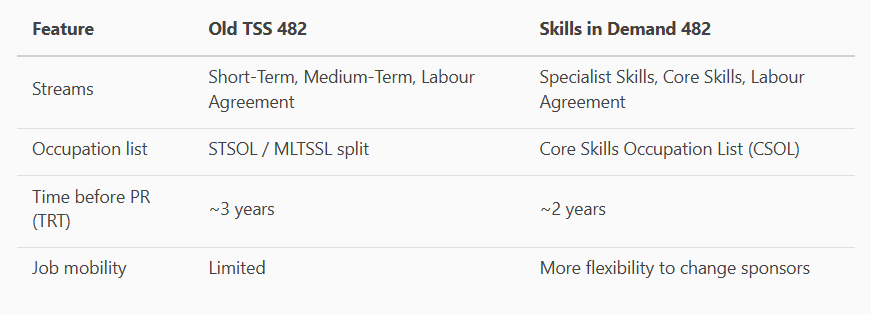
The headline shift is that the 482 is no longer split into Short-Term and Medium-Term streams tied to two separate occupation lists.
The Skills in Demand visa now runs on a cleaner two-stream model, with a single consolidated occupation list (the Core Skills Occupation List) sitting underneath it.
The other major change is the permanent residence timeline.
Under the old rules, many workers waited around three years before they could transition to employer-sponsored PR.
Under Skills in Demand, the qualifying period for the Temporary Residence Transition pathway to the subclass 186 has been reduced to around two years of holding the visa with the sponsoring employer.
The two streams explained
Specialist Skills Stream
This stream is built for high-earning, in-demand professionals.
It does not depend on a specific occupation being on a list in the same way the Core Skills Stream does; instead, eligibility is driven by a high salary threshold.
The trade-off for the employer is speed — processing for this stream is targeted at around seven days.
If you are recruiting a senior engineer, a specialist clinician, a software architect or an executive on a strong package, the Specialist Skills Stream is usually the fastest path to getting them on the ground.
Core Skills Stream
This is the workhorse stream for most Brisbane employers.
It covers occupations on the Core Skills Occupation List (CSOL), which contains 456+ occupations spanning trades, healthcare, hospitality, construction, IT and professional roles.
The nominated salary must meet the relevant income threshold and the market rate for the position.
If your role is on the CSOL and the salary sits below the Specialist threshold, this is your stream.
Occupation lists: check the CSOL first
The single most important early step is confirming the nominated occupation appears on the Core Skills Occupation List.
The CSOL replaced the old short and medium-term lists and was rebuilt using labour market analysis, so some occupations that previously qualified may now sit differently, and some that were excluded are now in scope.
Before you advertise a role or make an offer, check:
Is the occupation on the CSOL (or does the salary clear the Specialist threshold)?
Does the candidate's skills and experience genuinely match the occupation's tasks?
Does the proposed salary meet both the income threshold and the market rate for the role?
Getting the occupation match wrong is still the most common reason nominations are refused.
Costs: what to budget
The fees below are indicative as at June 2026 and should be confirmed before you lodge, as government charges are reviewed regularly.
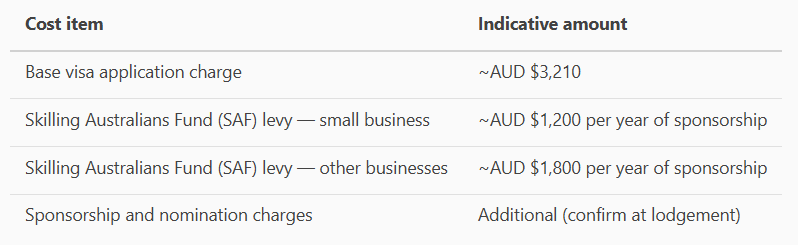
The SAF levy is paid by the employer, upfront, and is calculated per year of the nomination period.
A small business sponsoring a worker for four years is therefore looking at a meaningful upfront cost on the levy alone, before professional fees and the visa charge.
Plan your cash flow around this.
Processing times
Processing is one of the strongest selling points of the new system, but it varies sharply by stream:
Specialist Skills Stream: around 7 days (priority processing for high-paid roles)
Core Skills Stream: roughly 1 to 4 months, with a median around 21 days for well-prepared applications
The gap between the median and the upper end usually comes down to preparation.
Complete nominations with clear evidence of the occupation match, salary and labour market testing move quickly; incomplete ones sit in requests for further information.
The permanent residence pathway
The reduced PR timeline is the change most likely to help you retain staff.
Under the Temporary Residence Transition (TRT) stream of the subclass 186 (Employer Nomination Scheme), a Skills in Demand visa holder can generally be nominated for permanent residence after holding the visa and working for the sponsoring employer for around two years.
For employers, this is a retention tool.
A worker who can see a credible two-year route to PR with your business is far more likely to stay than one facing a longer, less certain wait.
Build that conversation into your hiring pitch.
What Brisbane employers should do now
Confirm your Standard Business Sponsorship is current. If it has lapsed or is close to expiry, renew before you nominate.
Check the occupation against the CSOL (or test it against the Specialist salary threshold) before making an offer.
Budget for the full cost, especially the upfront SAF levy across the full nomination period.
Decide on the stream early — Specialist for speed on high-paid roles, Core Skills for everything else.
Map the PR conversation into your retention strategy using the ~2-year TRT pathway.
Get the nomination right the first time — refusals cost time and money you cannot easily recover.
Frequently asked questions
Is the old TSS 482 still being granted?
The subclass 482 continues, but it now operates as the Skills in Demand visa with new streams and rules.
The old TSS structure no longer applies to new applications.
Do existing 482 holders need to do anything?
Workers already on a 482 generally continue under the conditions of their grant.
The new rules matter most for new nominations and for planning the PR transition.
Confirm your specific situation with a Registered Migration Agent.
Which stream is cheaper?
The base visa charge and SAF levy are broadly the same regardless of stream.
The Specialist Skills Stream's advantage is speed, not a lower fee.
How long until my worker can apply for PR?
Under the Temporary Residence Transition pathway to the subclass 186, generally around two years of holding the Skills in Demand visa with the sponsoring employer.
Are these fees fixed?
No.
The figures here are indicative as at June 2026.
Government charges and the SAF levy are reviewed periodically, so confirm current amounts before lodging.
Related reading
The 482 to 186 PR pathway: what employers and workers need to know
Standard Business Sponsorship: a step-by-step guide for Brisbane businesses
Labour market testing for employer-sponsored visas
Book a consultation
Sponsoring overseas talent under the Skills in Demand visa is faster than the old system — but only when the occupation match, stream choice and nomination are handled correctly.
With 322+ five-star Google reviews, Nationwide Migration & Education helps Brisbane employers get it right the first time.
Book a consultation with Suman Dua, Registered Migration Agent (MARN 1800859), at Level 4, 320 Adelaide Street, Brisbane — or visit nationwidemigration.com.au.
Disclaimer
This article is general information only and not immigration advice.
Nationwide Migration & Education is not affiliated with the Australian Government and does not issue visas.
For advice on your situation, book a consultation with one of our Registered Migration Agents.
