
Construction Worker Shortage Australia: Sponsor Skilled Trades
📌 Published by Nationwide Migration & Education
Author: Suman Dua, Registered Migration Agent (MARN: 1800859)
If you run a building, construction, civil, renovation, residential home building or trade business in Australia, you already know how difficult it can be to find reliable skilled workers. A good carpenter, bricklayer, roofer, tiler, plasterer, plumber, site supervisor or machinery operator can make a major difference to your projects, timelines, client satisfaction and profitability. When one of those workers is on a Working Holiday visa, student visa, graduate visa or another temporary visa that is about to expire, losing them can create an immediate staffing gap that is expensive and disruptive to replace.
The important point for employers is this: before you let a good worker leave Australia because their visa is expiring, it may be worth checking whether employer sponsorship is possible. Not every worker or employer will qualify, and visa outcomes are decided only by the Department of Home Affairs. However, for some construction businesses, an employer-sponsored visa pathway may be a practical way to retain proven skilled staff instead of restarting recruitment every few months.
Nationwide Migration and Education does not sell, issue or provide visas. Visa decisions are made solely by the Australian Department of Home Affairs. This article is general information only and should not be treated as migration advice for your specific circumstances. Employers should obtain professional advice before making sponsorship decisions.
Why construction employers should think about visa sponsorship as a retention strategy
Australia’s construction labour market remains under pressure. Infrastructure Australia’s 2025 Infrastructure Market Capacity Report states that Australia’s current infrastructure workforce stood at 204,000 workers as at October 2025, with an estimated 141,000-worker shortage that could reach 300,000 by 2027.
The same report identified labour and skills shortages as a substantial delivery risk, with surveyed firms citing labour cost and labour or skills shortages as major threats to project delivery.
Jobs and Skills Australia has also confirmed that, although national labour market pressures eased in the 2025 Occupation Shortage List, nearly half of trade roles remained in shortage, particularly in health, education and construction.
The agency identified insufficient qualified applicants as a leading driver of shortages, including in construction. In practical terms, many employers are not simply dealing with a temporary hiring inconvenience. They are facing a structural talent constraint.
For the building industry specifically, the Housing Industry Association reported that improved access to skilled labour from overseas was helping to contain, but had not yet eased, the shortage of skilled tradespeople.
HIA also reported that more than 8,600 subclass 457/482 visa holders were sponsored by the construction industry at the end of 2025, double the number from only a few years earlier.
This suggests that more employers are treating sponsorship not only as a migration process, but as part of their workforce planning strategy.
Employer Challenge vs Sponsorship Considerations
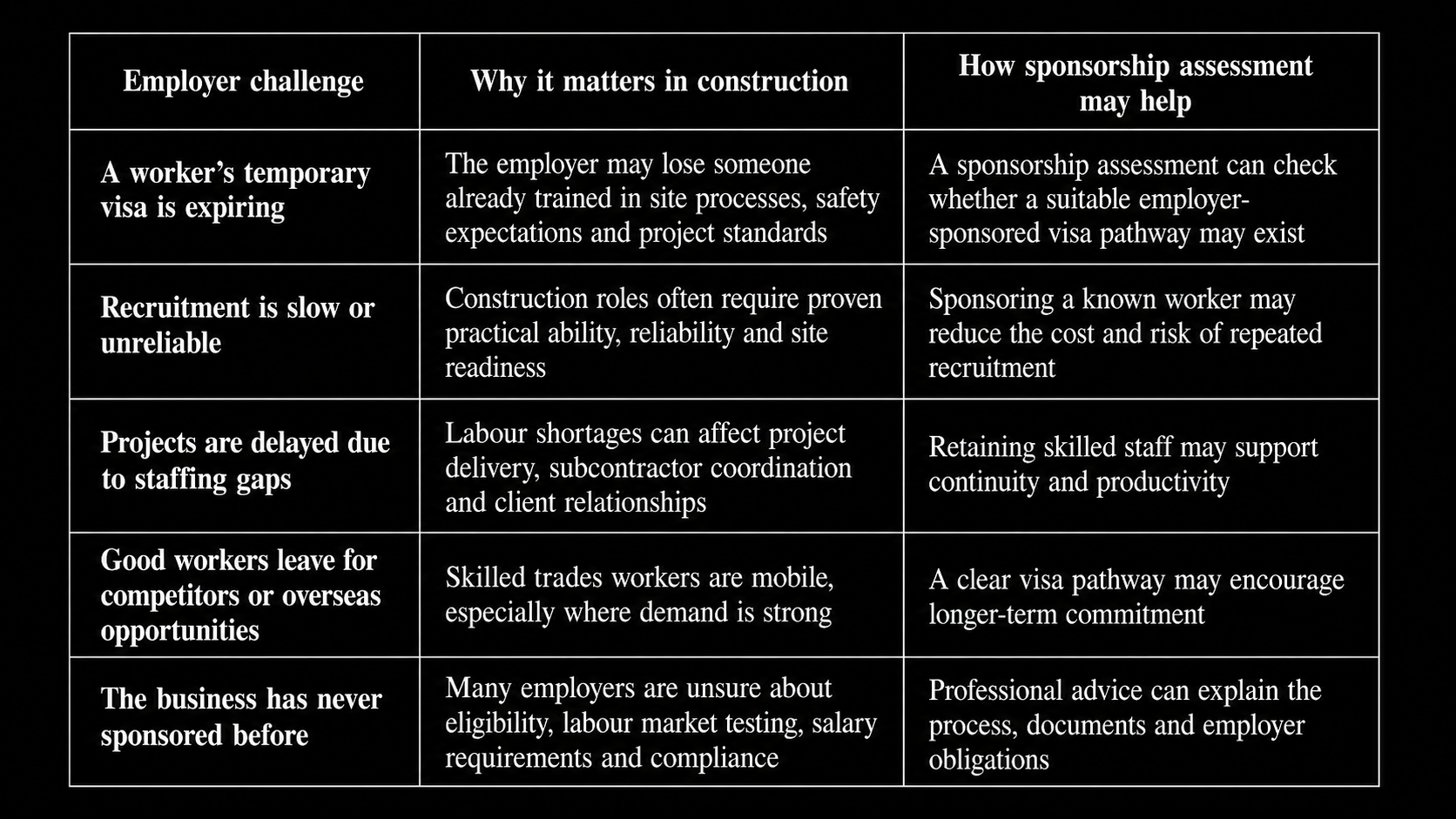
The real cost of losing a good construction worker
When a skilled worker leaves, the cost is not limited to advertising a new job. There is time spent screening applicants, interviewing, checking references, trialling workers, training them on your systems and rebuilding trust with supervisors and clients.
For trade employers, the cost can be even higher because a poor hire can affect workmanship, safety, project timing and team morale.
A worker who has already demonstrated reliability on site has a value that is difficult to replace. They understand how your business operates, how your team communicates, how your projects are delivered and what standard of work you expect.
If that person is on a Working Holiday visa or another temporary visa and is about to leave Australia, the business should consider whether there is enough time to assess options before the visa expires.
This is where a construction visa sponsorship assessment becomes commercially relevant.
The question is not simply, “Can we sponsor this worker?”
The better question is, “Is it worth assessing whether sponsorship could help us retain a skilled worker who is already performing well?”
In many cases, the cost of exploring an employer-sponsored visa pathway may be lower than the cost of repeatedly recruiting, training and replacing staff.
What is an employer-sponsored visa for construction workers?
An employer-sponsored visa allows an Australian employer to nominate or sponsor an overseas worker for a skilled role where the employer cannot source an appropriately skilled Australian worker.
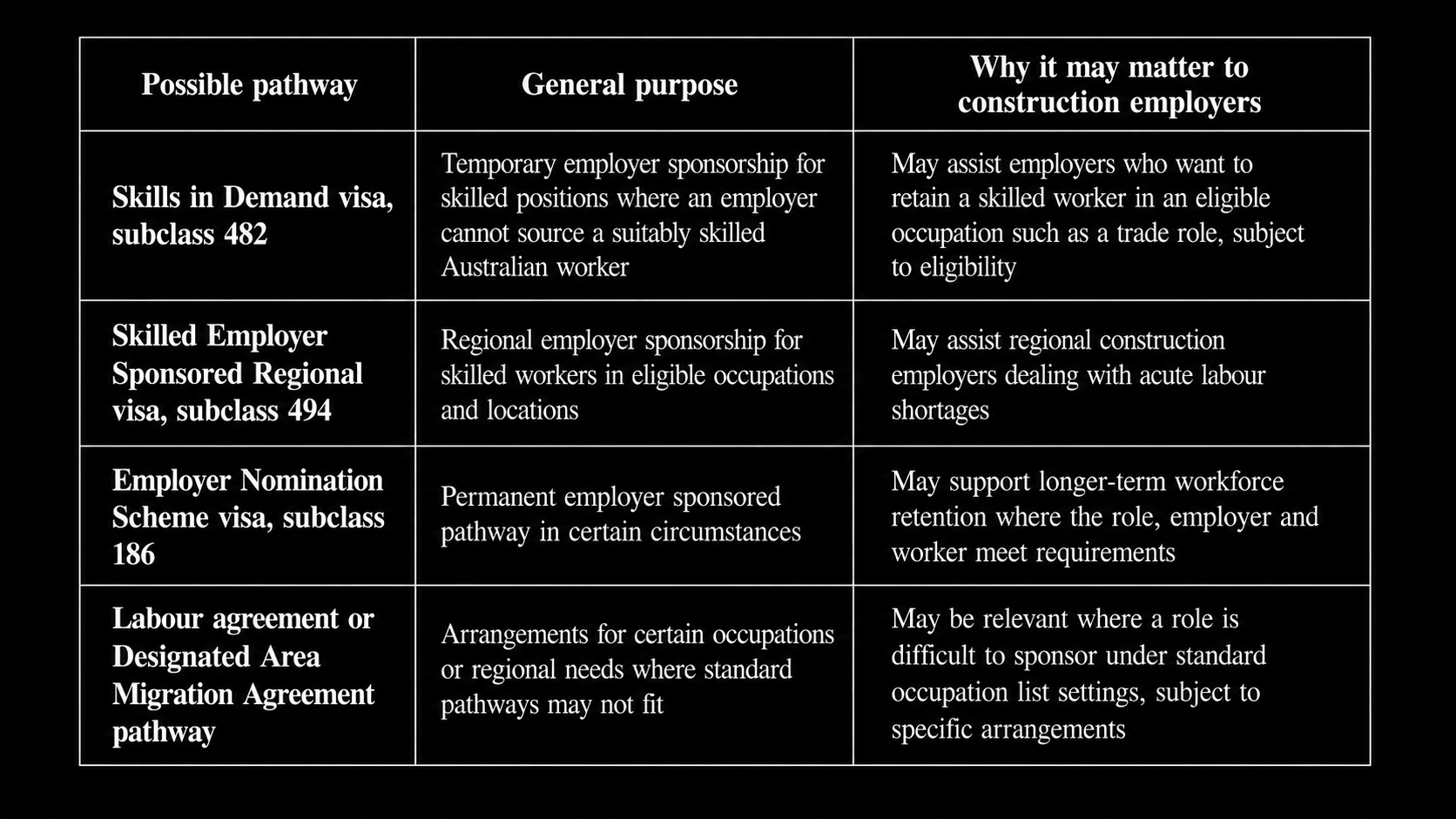
The most relevant pathways for many employers include:
Skills in Demand visa, subclass 482
Skilled Employer Sponsored Regional visa, subclass 494
Employer Nomination Scheme visa, subclass 186
The correct pathway depends on the occupation, location, salary, work experience, skills assessment requirements, employer eligibility and the worker’s circumstances.
The Department of Home Affairs describes the Skills in Demand visa, subclass 482, as a temporary visa that lets an employer sponsor a suitably skilled worker to fill a position they cannot find a suitably skilled Australian to fill.
For regional employers, the subclass 494 visa may also be relevant.
Employer-Sponsored Visa Pathways for Construction Employers
Can an employer sponsor a worker on a Working Holiday visa?
A worker on a Working Holiday visa may be performing well in a construction business but approaching the end of their stay.
In that situation, the employer should not assume that the only option is to let them go.
Depending on the worker’s occupation, qualifications, experience, English ability, visa history and the employer’s ability to meet sponsorship requirements, a sponsorship pathway may be worth assessing.
For example, a carpenter, bricklayer, roofer, tiler, plasterer, plumber, electrician, welder, construction project worker or other tradesperson may have experience that is valuable to the business.
However, eligibility is never automatic.
The occupation must be considered against the relevant skilled occupation list or pathway, and the worker may need to meet skills, English, health, character and other requirements.
Some nominees may also need a skills assessment from the correct assessing authority.
The safest approach is to seek advice early.
Waiting until the worker’s visa is close to expiry can reduce available options and create unnecessary urgency.
If the employee is valuable to the business, the employer should consider an assessment while there is still time to plan.
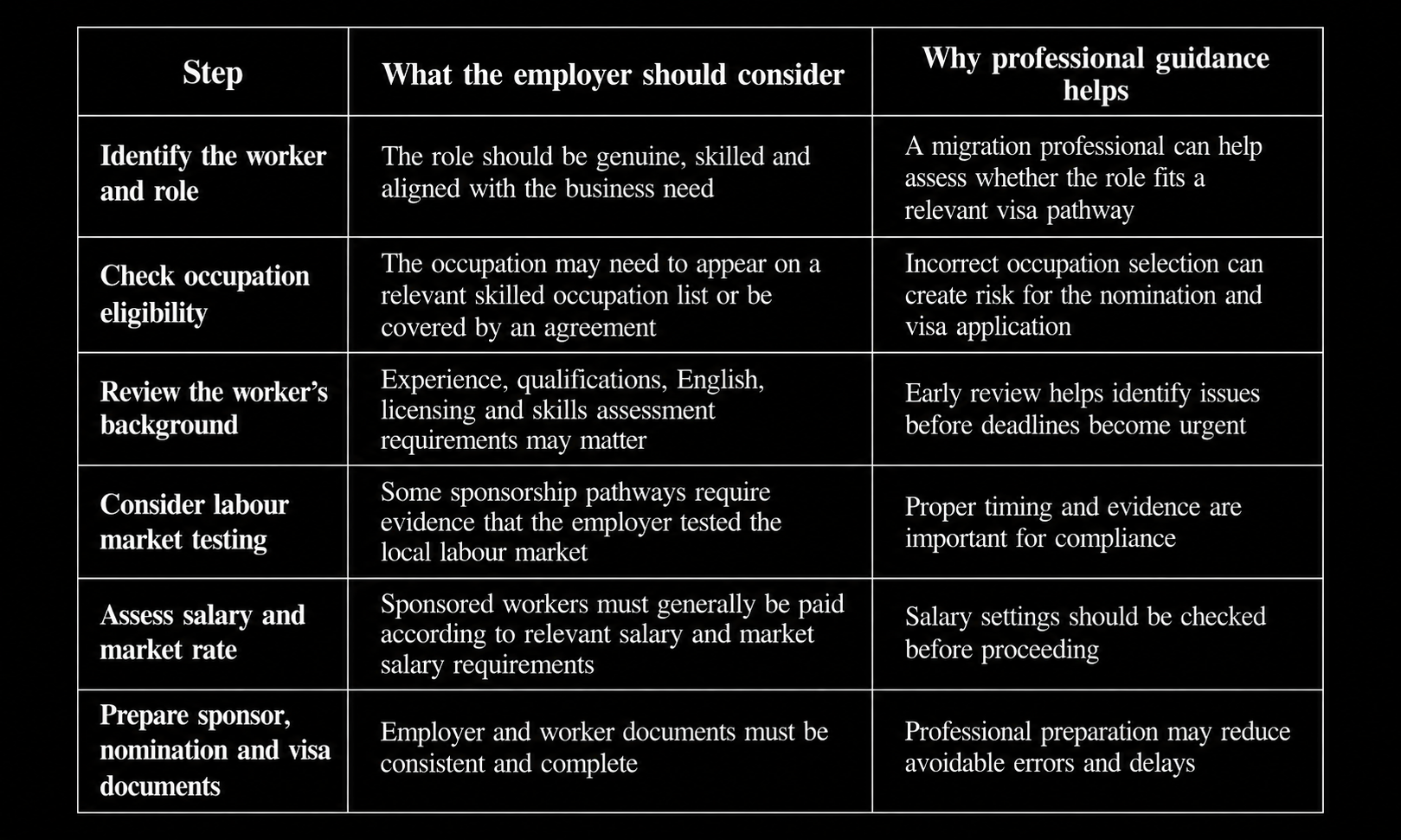
What does the employer sponsorship process usually involve?
Home Affairs explains that the specific requirements, process and documents depend on the visa option selected.
In general, employers may need to:
show they cannot find a person in Australia to fill the vacancy
provide evidence of labour market testing where required
confirm that the occupation is on an eligible skilled occupation list or covered by an appropriate agreement
check business eligibility to sponsor
apply to become an approved sponsor or nominator
nominate the occupation
support the worker’s visa application process
The employer must also pay the skilled worker no less than the applicable market salary rate for the occupation and in accordance with visa or nomination requirements.
This is why sponsorship should be handled carefully.
It is not simply a form; it is a compliance process involving the employer, the role, the salary, the worker and the relevant visa criteria.
Employer Sponsorship Process Considerations
Why sponsorship can be cheaper than constant recruitment
Employers often hesitate because they assume sponsorship is expensive or complicated.
Sponsorship does involve costs, time and compliance obligations.
However, the alternative may also be expensive.
If a business keeps losing skilled staff because their visas expire, the employer may face:
repeated job advertising
agency fees
supervisor time
training time
project delays
lower productivity
inconsistent work quality
For many construction businesses, staff retention is not just an HR issue.
It is a commercial issue.
The cost of losing a good worker can show up in delayed handovers, missed milestones, increased overtime, subcontractor pressure and reduced capacity to accept new work.
If an employee is already trained, reliable and valuable, it can be sensible to assess whether sponsorship could support longer-term retention.
Which construction occupations may be worth assessing?
The right visa pathway depends on the specific occupation, duties and current migration settings.
However, construction employers commonly seek advice about trade and construction roles such as:
carpenters
joiners
bricklayers
stonemasons
roof tilers
wall and floor tilers
plasterers
plumbers
electricians
welders
painters
cabinetmakers
metal fabricators
civil construction workers
plant operators
site supervisors
construction project managers
other skilled building workers
Not all occupations will qualify in the same way, and some roles may require licensing, skills assessments, minimum experience or specific English outcomes.
The key is to assess the worker against the actual nominated occupation, not just their job title.
When should employers seek advice?
Employers should seek advice as early as possible when:
a valued international worker’s visa is due to expire
a worker asks about sponsorship
the business cannot fill a trade role locally
a regional project is delayed due to labour shortages
the business is considering hiring a skilled overseas worker
Early advice allows time to review:
the worker’s eligibility
occupation fit
employer eligibility
labour market testing
documentation requirements
A practical rule is simple:
If you would be disappointed to lose the worker, assess the options before they leave.
How Nationwide Migration and Education can help construction employers
Nationwide Migration and Education assists employers and skilled workers with professional guidance on employer-sponsored and work visa pathways in Australia, including subclass 482, subclass 494 and subclass 186 pathways.
The business is positioned to help employers dealing with:
skill shortages
staff retention concerns
labour market testing
sponsorship paperwork
compliance planning
For construction employers, the service is especially relevant where a skilled worker is already onshore, already working well and at risk of leaving because their visa is expiring.
Instead of losing that worker automatically, the employer can book a consultation to assess whether sponsorship may be available and what steps would be required.
If you are a builder, construction company, trade business, subcontractor, civil contractor or regional employer struggling to retain skilled workers, speak with Nationwide Migration and Education before you let a good worker go.
Frequently asked questions
Can I sponsor a construction worker in Australia?
It may be possible if your business, the role and the worker meet the relevant visa requirements. The occupation, salary, worker’s skills, experience, English ability and employer sponsorship obligations all need to be assessed.
Can I sponsor someone on a Working Holiday visa?
A worker on a Working Holiday visa may be eligible for another pathway, including employer sponsorship, but this depends on their occupation, experience, qualifications, visa history and the employer’s circumstances.
Is subclass 482 still available for construction workers?
The Skills in Demand visa, subclass 482, allows employers to sponsor suitably skilled workers where they cannot find a suitably skilled Australian worker, subject to the relevant stream and eligibility criteria.
Is sponsorship only for large construction companies?
No. Smaller employers may also be able to sponsor skilled workers if they meet the relevant sponsorship, nomination and compliance requirements.
Does sponsorship guarantee permanent residency?
No. Sponsorship does not guarantee visa approval or permanent residency.
Should I wait until the worker’s visa is about to expire?
No. Employers should seek advice early because labour market testing, documents, skills assessments and visa timing can take time.
Book a Discovery Call
If you are a builder, construction company, trade employer or subcontractor dealing with staff shortages or a skilled worker whose visa may be expiring, Nationwide Migration and Education can help assess potential employer-sponsored visa pathways.
This complimentary discovery call is intended for Australian employers, business owners, HR representatives, or authorised decision-makers only.
Disclaimer
Nationwide Migration and Education is a private migration consultancy registered with MARA and is not affiliated with the Australian Government.
Nationwide Migration and Education does not sell, issue or provide visas.
All visa decisions are made solely by the Australian Department of Home Affairs.
This article provides general information only and is not a guarantee of eligibility, visa approval or migration outcome.
